How Casino Stories Travel Through Trà Vinh
Casino culture in Trà Vinh appears in stories, entertainment, and public language. Trace how a motif changes meaning as it moves between settings.
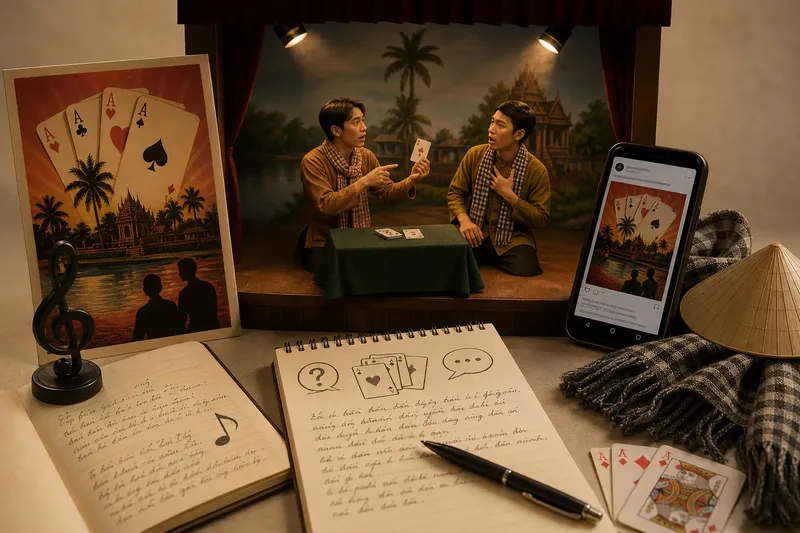
Where does casino culture in Trà Vinh appear when a casino is not the subject? A card table in a stage sketch, a wager in a song, or a familiar phrase about luck can give the theme a place in public entertainment without documenting local gambling habits. The useful question is how a particular work uses the motif—and what its chosen form lets the audience see.
Casino culture in Trà Vinh depends on the form carrying it
A stage sketch, a song, a poster, and a social post each offer different ways to frame casino themes. A sketch can use timing and dialogue; a song can repeat a phrase until it sounds playful or uneasy; a poster can rely on a single bold image. These are choices made by a particular creator, not evidence of a shared local custom.
When discussing a work, name the format and describe the evidence it provides. A recording may establish what a performer said, while a caption may establish how a poster was presented online. Neither source automatically establishes where an image originated or how audiences interpreted it.
Public performance can frame casino imagery as spectacle
Entertainment often makes a motif noticeable through repetition, contrast, or timing. Bright colors and an emphatic musical cue can make a card image feel celebratory; a pause or a deliberately awkward line can make the same image comic or critical. The effect comes from the whole performance, not from the symbol alone.
Say you are reviewing an invented community theater sketch advertised in Trà Vinh. The program names a card game, but the script uses the cards as a prop in a comic misunderstanding. Describe the program’s wording, the visible prop, and the joke’s timing; do not turn those details into a claim about local gambling practices. If the program does not identify the performance venue, say that the venue is unknown rather than filling the gap with an assumption.
It is not worth the effort to infer a broad cultural message from a costume, a playing card, or a decorative sign by itself. A precise account of the performance’s framing is more useful than an unsupported claim about what a whole community believes.
Public language gives casino themes a local setting
Words such as “luck,” “risk,” and “wager” can refer to a game, a joke, or an uncertain decision. Their meaning depends on the speaker, the surrounding words, and the situation. A phrase in a script is evidence of that script’s language; it does not, on its own, establish how people in Trà Vinh use the phrase in everyday conversation.
Translation can also alter tone. A translated line may preserve its basic meaning while losing a pun, a form of politeness, or a speaker’s qualification. When tone is unclear, present the wording and explain the uncertainty instead of choosing a more confident interpretation than the source supports.
What evidence supports a reading of casino culture in Trà Vinh?
Does a story set in Trà Vinh document local practice?
It documents what the story depicts and how it names its setting. Treat claims about actual local practice as a separate question requiring sources that address that practice directly.
How can a reader distinguish a game from a metaphor?
Look for the actions and dialogue around the image: are characters playing, or is the object being used to express uncertainty? If the scene does not settle the matter, describe the ambiguity rather than assigning a definite meaning.
What should a writer do with an uncertain translation?
Identify the translated wording and state what remains unclear, such as a joke or a speaker’s tone. If the original wording is available, compare it before presenting an interpretation as settled.
Can one performance represent a community?
A performance can show how its creators frame a subject for that work. One performance does not establish a shared community attitude, so broader claims need evidence that directly supports them.
A careful description separates observation from interpretation
For a useful account, record what the source actually shows or says, then identify any interpretation as an interpretation. These checks help keep the two apart:
- If a program names Trà Vinh but gives no venue, report that it names the province; if a precise location matters, seek a source that identifies the venue.
- If a performance shows cards without depicting a game, describe the cards as props; if identifying a game matters, look for clear actions or dialogue before naming it.
- If a caption calls an image local but names no creator or source, attribute that description to the caption; if origin matters, locate the original publication.
- If a character uses “luck” while discussing a difficult choice, describe the figurative reading as plausible; if the surrounding dialogue is missing, mark the meaning as uncertain.
- If a translated line omits a qualification present in the source, preserve the narrower claim; if the original is accessible, compare the wording before interpreting it.
- If a sketch makes a character’s decision look risky, describe how that character is portrayed; if discussing a wider social pattern, use sources that address that pattern directly.
One invented performance shows how to trace a motif
Imagine an invented short stage sketch advertised for a community hall in Trà Vinh. Its program lists one card table and two performers; in the scene, one performer points to a card while the other says, “That’s a gamble,” about accepting a new role. First, note the starting evidence: the program’s location claim, the listed table, the two performers, and the line. Next, follow the action: neither performer plays a hand, and the dialogue concerns a decision, so the cards function as a prop rather than evidence of a game. Finally, compare the program with the performance: the program establishes an advertised setting, but not by itself the event’s actual venue. The resulting description can say that the invented sketch uses card imagery as a comic metaphor for a decision, while leaving both the precise venue and any claim about local practice unasserted.
For casino culture in Trà Vinh, the most grounded account names the source, describes its format, and separates what it shows from what a reader infers. That distinction lets a performance or phrase be understood on its own terms without making it stand for a place or its residents.